Can You Use Blue Light if Youre Using Retina

For beach-goers, experts ever recommend a healthy coating of sunscreen to protect the pare from those pesky ultraviolet (UV) rays. But sunlight contains more than just UV light. In fact, it's made upwardly of cherry, dark-green, xanthous, blue and orange low-cal rays, which combine to create "white light" (a.g.a. sunlight). If yous haven't sat through a high school chemistry class in a while, no worries. Nosotros'll break down the important stuff — without getting too scientific.
As the name suggests, visible light can be seen by the man eye, and each ray reflects a particular colour. The color of a given ray depends on said ray's wavelength (see the graphic below) — or the distance between successive crests of a wave. (Side annotation: This ways that objects get their colors through the wavelength of the light that is reflected from them. Trust united states — don't think likewise hard about it. Things get trippy.)
Another of import relationship to annotation is that of wavelengths and energy: The longer the distance between waves, the less energy a ray has to offer. Think of information technology this way — if the wave crests are further autonomously, they're a fleck lackadaisical, but if the crests come in rapid succession, there's a frenzy of energy there. All of this means rays on the red end of the visible light spectrum have longer wavelengths and less energy, whereas rays on the blue end have shorter wavelengths and more than energy.
UV rays, which aren't on the visible light spectrum, surpass blueish light in terms of how much free energy they contain. That incredible amount of free energy is how those rays are able to create a physical change, like tanning (or called-for) 1's peel. In moderation ultraviolet radiation can be practiced for us (call up vitamin D!), but, on the other hand, it can also produce some devastating effects (think sunburn and snow blindness!).
How Does Blue Low-cal Bear on 1's Health?
But what about blue lite — these visible rays that are a few notches beneath harmful UV rays? Well, approximately ane-tertiary of all visible low-cal is considered loftier-energy visible (HEV) blue light. Bluish light is literally why the heaven appears blue: These rays scatter more easily than other visible rays of light when they strike the atmosphere's air and water molecules — and all that scattering makes the sky that vibrant blue.
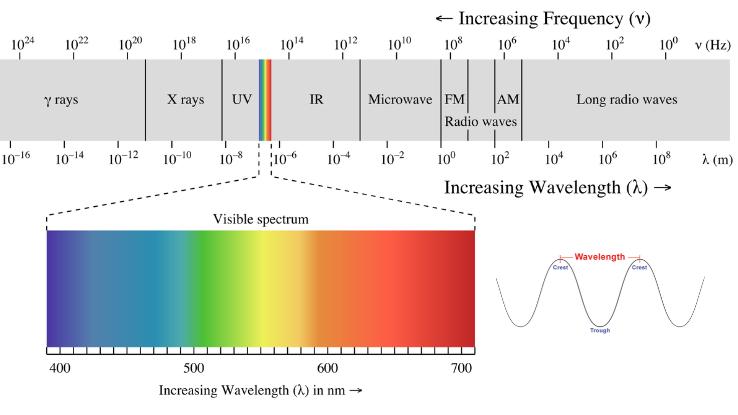
There'southward no escaping it, especially because daylight is our principal source of blue light. But it's not all bad: Experiencing blueish low-cal during the daytime helps regulate one'southward circadian rhythms, makes 1 more alert, elevates cognitive function, promotes skillful recall and is even used in light therapy to treat seasonal melancholia disorder (Deplorable). However, human-made objects — including LED lights and display screens on flat-screen TVs, computers and smartphones — emit bluish lite too. Although these devices only emit a fraction of the blue light the dominicus emits, researchers and doctors take still voiced concerns about patients' excessive screen time in contempo years.
Possibly surprisingly, the man middle is pretty neat at protecting the retina from UV rays, only blue lite is a different story. Virtually all of it penetrates the light-sensitive retina, causing harm that approximates macular degeneration — a status that can lead to vision loss.
In addition to potentially harming your optics over fourth dimension, blue light can also lead to heart strain. If you've ever ended up with a wicked headache after staring intensely at an Excel spreadsheet for hours, you're probably familiar with that particular discomfort. When we noted how blue lite contributes to the sky looking blueish, we mentioned that this is so because of how blue light scatters. Well, co-ordinate to All About Vision, this same handful of the blue light that emanates from screens makes for "unfocused visual 'racket' [that] reduces contrast and can contribute to digital eye strain."
If you lot don't suffer from middle strain due to increased exposure to blueish light, these inescapable rays may however accept adverse effects on your health. Whatsoever sort of lite — regardless of where it falls on the spectrum — can suppress the human body's power to release melatonin, the hormone that regulates sleep cycles. However, it's thought that blueish low-cal quashes melatonin secretion fifty-fifty more than than other hues do. Researchers at Harvard University compared the effects of blue and green calorie-free exposure and found that "blue calorie-free suppresses melatonin [secretion] for about twice as long equally the green low-cal and shifted cyclic rhythms by twice as much."
BluTech, a company that manufactures special blue light-filtering lenses, reports that "43% of adults have a job that requires prolonged utilize of a tablet or figurer" — and that's simply while said adults are on the clock. Factor in all that time we spend online, texting and marathoning Netflix, and adults spend roughly 12 hours a day looking at screens and taking in blue low-cal. And so, how can you mitigate the harmful furnishings of prolonged exposure to blue light?

Well, these blue light-filtering lenses are becoming all the rage. Although not as ubiquitous every bit Away suitcases or Blueish Apron commercials, yous've probably heard commercials for blueish light-filtering specs from Felix Grayness or Warby Parker on your favorite podcast or radio talk show. Felix Gray glasses, for instance, pride themselves on having a blue light-filtering fabric embedded within, which the visitor says volition curb eye strain, headaches and sleep disruption.
If yous're not into the glasses route, experts recommend taking screen breaks, both at work and at habitation; keeping screens clean to reduce glare and farther centre strain; changing your abrasive white display groundwork to something less brilliant; blinking more than often; and avoiding screens for at least xxx minutes to an hr earlier bed because screens stimulate your brain. Maybe it's time to trade that fancy bluish calorie-free-emitting tablet for a Kindle Paperwhite, or, you know, a good quondam-fashioned book.
Source: https://www.faqtoids.com/health/blue-light-facts?utm_content=params%3Ao%3D740006%26ad%3DdirN%26qo%3DserpIndex
0 Response to "Can You Use Blue Light if Youre Using Retina"
Enregistrer un commentaire